Before play
Set a shared intention, clarify roles, and decide who makes which calls.
Shared practice
Teamwork grows through repeated choices: sharing useful information, understanding roles, responding well to mistakes, and reviewing decisions together.
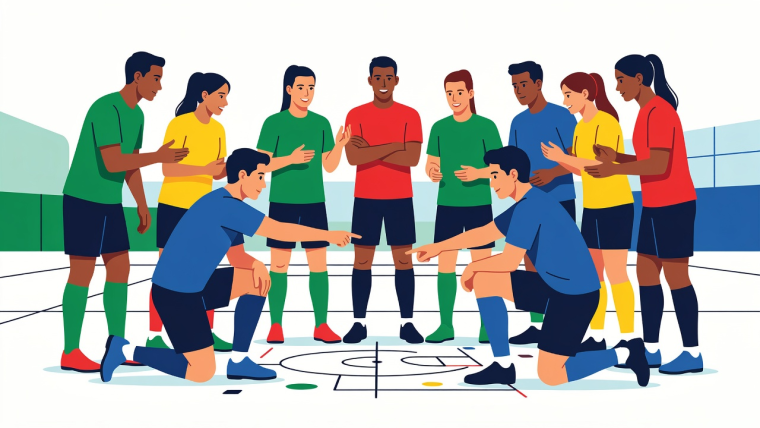
A team can begin by agreeing what information matters most in a match. Concise calls help teammates make decisions without adding unnecessary noise. Players can practice confirming a plan, naming a change, and checking whether everyone understands the next move.
Set a shared intention, clarify roles, and decide who makes which calls.
Use short, relevant communication that supports decisions in real time.
Identify one team choice to keep and one to test differently.
Carry the lesson into practice and check that the plan still fits.
Trust does not require everyone to agree all the time. It means teammates can raise a concern, explain their reasoning, and work toward a decision without personal attacks. Coaches can model this by separating a player's identity from a particular in-game choice.
Review sessions work best when the group looks at a shared moment and asks what information was available. A blame-focused conversation can make players hide uncertainty; a learning-focused discussion gives them a reason to communicate earlier next time.
Teams also benefit from practical routines: a calm reset after a difficult round, an agreed way to pause a discussion, and a regular check-in about workload. These habits make improvement more repeatable than relying on motivation alone.
Talk about the observed action and its effect rather than assigning a character judgement.
Ask what teammates saw and what they would need next time.
Agree on a concrete adjustment and review it after another practice.
A healthy academy has clear standards for respectful behavior and a process for addressing harassment or conflict. Ask staff how concerns are reported, who responds, and how players are supported. Strong team culture is designed and maintained; it is not guaranteed just because players share a roster.
Prepare for competitionYour privacy choices Some cookies are needed for the site to work. Others help us understand how it is used. You can change your choice later. Read more